Andhra Pradesh is widely celebrated as the “rice bowl of India”. Farming isn’t just an occupation here—it’s the very lifeblood of the state. In fact, agriculture and allied sectors contribute an incredible 33.2% to Andhra Pradesh’s Gross State Domestic Product (GSDP), making it one of the highest agricultural shares in the country.
To empower and support this massive farming community, state and central governments run various direct income support initiatives. Over the years, shifting political administrations have introduced, revised, and renamed these welfare policies, leading to a competitive cycle of welfare strategies. The flagship farmer investment support program in Andhra Pradesh has recently undergone its latest major update.
Under the leadership of Chief Minister N. Chandrababu Naidu, the state government has transitioned the program back to its original programmatic roots: the Annadata Sukhibhava scheme. This upgraded initiative is designed to provide robust economic empowerment directly to the bank accounts of over 51 lakh hardworking farming families across the state.
In this comprehensive guide, we will break down everything you need to know about the Annadata Sukhibhava scheme in 2026—from its historical rebranding and financial architecture to step-by-step online status checks, technical troubleshooting, and grassroots policy controversies.
Programmatic Origins, Historical Rebranding, and Policy Trajectory
The history of agricultural investment support in Andhra Pradesh is a fascinating case study in policy evolution. To truly understand the current 2026 model, we have to look back at how the program’s trajectory has been shaped by consecutive state administrations.
The Initial Launch (February 2019)
The program was originally launched in February 2019 under the Telugu Desam Party (TDP) administration as the Annadata Sukhibhava scheme. The initial version was designed to assist approximately 39.33 lakh small and marginal farmers, backed by a state budgetary allocation of ₹5,000 crore.
Under the 2019 guidelines, the state government offered direct cash assistance alongside enhanced input subsidies for several high-cost crop categories. Subsidies for crops like paddy, sugarcane, cotton, and groundnut were raised from ₹10,000 to ₹15,000 per acre, while maize subsidies increased from ₹8,333 to ₹12,500, and pulses and sunflower subsidies rose from ₹6,250 to ₹10,000. Additionally, the state provided a machinery subsidy of ₹2.5 lakhs for purchasing tractors to help smallholders improve farm mechanization. The initial rollout of this model disbursed a first installment of ₹1,000 per family through direct cash transfers.
The Saturation Model: YSR Rythu Bharosa (June 2019 – June 2024)
Following a state government transition in June 2019, the incoming YSRC administration replaced the TDP program with the YSR Rythu Bharosa-PM Kisan scheme. This revised model adjusted the annual financial assistance to ₹13,500 per family. It combined a state contribution of ₹7,500 with the central government’s contribution of ₹6,000 under the Pradhan Mantri Kisan Samman Nidhi (PM-KISAN) program. The YSRCP model utilized a saturation approach, supporting up to 53.58 lakh farmers—including tenant cultivators—and distributing ₹67,500 per family over a five-year period.
The Revamped Rebranding (June 2024 – Present)
With the return of the TDP-led National Democratic Alliance (NDA) coalition in June 2024, the state government rebranded the program back to Annadata Sukhibhava as a core component of its “Super Six” policy promises.
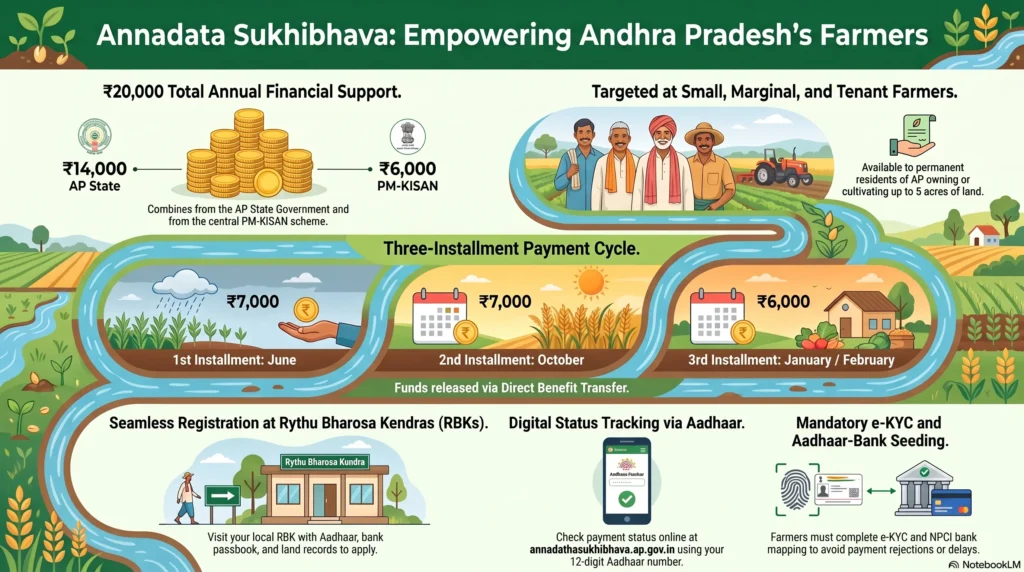
This updated iteration substantially increased the state’s financial commitment, raising its contribution from the previous state level of ₹7,500 to a landmark ₹14,000 per year. When combined with the central PM-KISAN component of ₹6,000, the integrated program provides a total of ₹20,000 annually to each eligible farming household.
This dual-funding arrangement functions as a “Double Engine” model. By leveraging both state and central resources, it ensures that even if local administrative issues delay state-level payments, the central PM-KISAN contribution maintains a baseline of financial support for registered families.
The Seasonal Installment Structure and Fund Disbursal
To align with the actual cropping cycles and provide liquid cash exactly when farmers need it, the ₹20,000 annual assistance is structured into seasonal installments.
The FY 2026-27 Installment Schedule
- First Installment (Kharif Sowing – June): ₹7,000 (₹5,000 AP State Contribution + ₹2,000 Central PM-KISAN Share).
- Second Installment (Rabi Sowing – October): ₹7,000 (Expected State and Central structured release).
- Third Installment (Harvesting/Summer – February): ₹6,000 (Expected State and Central structured release).
The June 20, 2026 Disbursal
On June 20, 2026, Chief Minister Chandrababu Naidu initiated the first major disbursal of the FY 2026-27 cycle. Speaking from Linganguntla village in the Chilakaluripet mandal of Palnadu district, the Chief Minister released a total of ₹3,125.47 crore under the scheme, directly benefiting 46,85,838 farming families.
Of this total, the state government provided ₹2,342.92 crore (₹5,000 per family), while the central government contributed ₹782.55 crore (₹2,000 per family) under the 23rd installment of the PM-KISAN program. The recipient database included 45,69,817 registered land-owning families and 1,16,021 tribal families cultivating land under the Record of Forest Rights (RoFR) Act, ensuring coverage for traditionally underserved agricultural communities.
Farm Utilization Patterns: How the Cash is Spent
According to recent academic studies on marginal and small paddy farmers in Andhra Pradesh, the utilization of these cash transfers is highly efficient for core agricultural tasks.
- Land Preparation: High utilization.
- Seed Purchase: High utilization.
- Harvesting Support: High utilization.
- Paying Machinery Rent: Moderate utilization.
- Fertilizers and Pesticides: Low utilization.
Policy Insight: Why is the use of direct cash transfers low for fertilizers and pesticides? This actually reflects a successful policy overlap. Because the state government provides high-quality fertilizers and pesticides at heavily subsidized prices directly at the point of sale, farmers do not need to exhaust their direct cash transfers on them. This allows the liquid cash to be redirected toward labor-intensive tasks like hiring workers for land preparation and harvesting.
Step-by-Step Guide to Check Your Payment Status Online
If you are an Andhra Pradesh farmer waiting for your seasonal installment, you do not need to visit a bank branch or district office to check your credit status. The government provides a simple, digital process to verify your details.
Method 1: The Official ADSB Portal (Primary Method)
Follow these step-by-step instructions to check your payment status online:
- Visit the Official Portal: Go to the official AP Annadata Sukhibhava website at annadathasukhibhava.ap.gov.in.
- Navigate to Beneficiary Status: On the homepage, look for the “Know Your Status” link.
- Enter Your Details: Select ‘Aadhaar Number’ from the search options and carefully enter your 12-digit Aadhaar number.
- Complete Captcha Verification: Carefully type the security CAPTCHA code exactly as displayed on the screen.
- Submit and View: Click the “Search” or “Get Data” button.
Your personalized payment dashboard will appear, displaying your name, district, mandal, village, e-KYC completion status, NPCI bank account mapping status, and transaction history for the 2026 installments.
Method 2: MeeBhoomi Land Record Verification
Because eligibility is directly linked to your land records, you should verify that your agricultural holdings are correctly recorded on the AP MeeBhoomi portal at meebhoomi.ap.gov.in. Ensure that your name, survey number, and total acreage match your Aadhaar card exactly. Any name spelling differences between your land records (1B/Adangal) and Aadhaar will block your DBT transfer.
Method 3: Village-Level Rythu Seva Kendra (RSK)
For farmers who prefer offline assistance or lack reliable internet access, local Rythu Seva Kendras (RSKs) continue to operate as physical verification hubs. RSK staff can use local terminals to check your status, initiate biometric fingerprint or face e-KYC, and resolve NPCI seeding errors.
Conclusions and Actionable Policy Frameworks
The Annadata Sukhibhava scheme represents a major policy commitment by the Government of Andhra Pradesh, delivering substantial direct financial assistance to small and marginal farmers. However, its long-term effectiveness in supporting rural livelihoods depends on resolving several administrative and programmatic bottlenecks.
To maximize the impact of the scheme and support sustainable agricultural growth, the following adjustments are recommended:
- De-link Tenant Verification from Landowner Consent: The state should explore alternative ways to verify tenant cultivators. Instead of requiring landowner signatures to secure a CCRC, the agriculture department could verify tenant cultivators through local gram sabhas (village assemblies) and e-crop records.
- Establish a State Crop Insurance Premium Subsidy: To cushion small and marginal farmers from high premium costs, the state could establish a premium subsidy model. This could automatically cover a portion of the premium for vulnerable crops like cotton and banana, ensuring crop risk mitigation remains affordable.
- Strengthen Digital Extension via Rythu Seva Kendras (RSKs): Field studies show that active engagement with RSK services improves farmers’ technical efficiency (TE) score to 0.82 compared to 0.71 for non-participating farmers. The government should expand RSK capabilities, resolving local seed and input shortages to help farmers optimize their resources.
By combining direct cash support with robust crop insurance, accessible tenancy frameworks, and localized digital extension, Andhra Pradesh can build a truly resilient, equitable, and prosperous agricultural economy.