Hey there! If you are living in Andhra Pradesh or have family members who do, you’ve likely heard about the NTR Bharosa Pension Scheme. Launched by Chief Minister N. Chandrababu Naidu’s TDP-led coalition government on July 1, 2024, this flagship welfare program represents a massive safety net designed to help the state’s most vulnerable citizens live with respect, dignity, and financial independence.
What is the NTR Bharosa Pension Scheme?
The NTR Bharosa Pension Scheme is AP’s state-funded social security program. It provides vital financial help to the elderly, widowed women, weavers, toddy tappers, and people living with severe physical or clinical challenges.
Named in honor of the legendary former Chief Minister Nandamuri Taraka Rama Rao (NTR), the program replaced the previous administration’s YSR Pension Kanuka scheme in June 2024. Along with the name change, the government brought in massive payout increases to offset inflation and rising medical costs, committing to the highest per capita spending on social pensions in India.
NTR Bharosa Pension Amount & Categories (2026 Updated Rates)
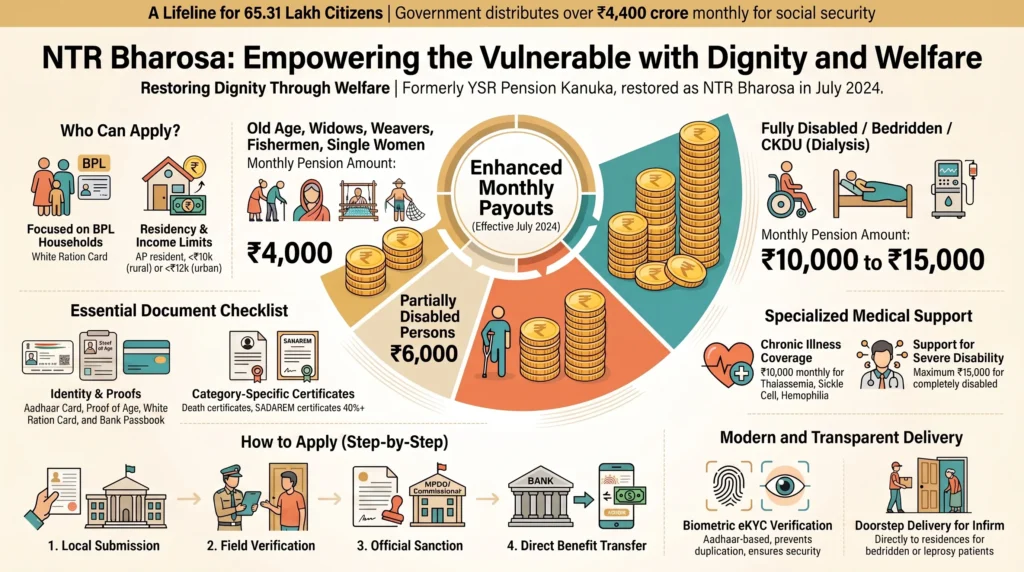
Under Government Order G.O. Ms. No. 43 issued on June 13, 2024, the state government updated the monthly payouts across all categories, making them effective retrospectively from April 2024. Payouts are now divided into a clear multi-tiered scale based on the severity of financial or physical hardship.
Let’s look at how much you or your loved ones can receive under the 2026 schedule:
A. Standard Welfare Payouts: ₹4,000/Month
This standard tier covers ten major social and vocational categories, raising the monthly amount from the historical ₹3,000 to ₹4,000:
- Old Age Pension (OAP): For senior citizens aged 60 or above who have little to no means of personal support.
- Widow Pension: For widowed or abandoned women aged 18 or above.
- Weavers Pension: For registered handloom weavers aged 50 or above.
- Toddy Tappers Pension: For registered toddy tappers aged 50 or above.
- Fishermen Pension: For traditional, BPL fisherfolk aged 50 or above.
- Single Women: For unmarried women (30+ in rural areas, 35+ in urban areas) with no family support, or divorced/separated women aged 35 or above who have been separated for more than one year.
- Traditional Cobblers: For traditional leatherworkers aged 40 or above.
- Transgender Persons: For transgender residents aged 18 or above.
- ART/PLHIV Patients: For individuals undergoing active Anti-Retroviral Therapy (ART) for at least 6 months.
- Dappu Artists: For traditional percussion performers aged 50 or above.
B. Disabled and Leprosy Pensions: ₹6,000/Month
To better support individuals facing moderate physical or mental disabilities, the payout was increased from ₹3,000 to ₹6,000 per month:
- Standard Disabled Pension: For residents of any age with a certified physical or mental disability between 40% and 79%, verified via a standard SADAREM certificate.
- Multi-Deformity Leprosy: For individuals of any age with visible physical deformities certified by the District Leprosy Officer (DLO).
C. Specialized Chronic Illness & Dialysis Pensions: ₹10,000/Month
Coping with a chronic illness can be emotionally and financially draining. The state provides ₹10,000 per month for individuals dealing with critical clinical conditions to help cover treatment costs:
- Chronic Kidney Disease (CKDU): For patients undergoing active, continuous renal dialysis at government or network hospitals.
- Bilateral Elephantiasis (Grade 4): Certified with Grade 4 disease severity.
- Organ Transplant Recipients: For kidney, liver, or heart transplant patients.
- Severe Renal Insufficiency: Certified with consistent serum creatinine levels exceeding 5 mg/dl on two tests taken at least 3 months apart.
- Extreme Renal Decline: Certified with an estimated GFR under 15 ml/min (KDIGO stage 5) or USG-confirmed bilateral small contracted kidneys.
D. Fully Disabled and Bedridden Pensions: ₹15,000/Month
This represents the highest pension tier in Andhra Pradesh. It was doubled from ₹5,000 to ₹15,000 per month to provide maximum support to families caring for severely compromised members:
- Bedridden or Paralyzed Individuals: For individuals of any age who are completely paralyzed or wheelchair-confined, with a certified SADAREM disability score exceeding 85%.
- Severe Muscular Dystrophy: For individuals with extreme muscle degeneration certified by a competent medical board.
The Specialized Under-18 Pediatric Health Pension Framework
Caring for a child with a chronic medical condition or severe disability is a deeply challenging journey. To support these brave families, the NTR Bharosa Pension Scheme includes an exceptionally compassionate under-18 pediatric framework.
Unlike many standard welfare programs, this specialized health-based framework has no minimum age requirements—meaning a child can qualify from infancy if they meet the strict clinical criteria. Payouts are calibrated directly to the medical needs of the child:
Pediatric Payout Schedule (Under 18 Years)
- Standard Pediatric PWD (₹6,000/Month): For children with a minimum of 40% physical or mental disability confirmed by a SADAREM certificate.
- Pediatric Thalassemia Major (₹10,000/Month): Requires lab reports and a medical board certificate signed by an Assistant Professor of Pathology.
- Sickle Cell Disease & Severe Haemophilia (₹10,000/Month): For children diagnosed with Sickle Cell or severe Haemophilia (where coagulation factor 8 or 9 levels are under 2%).
- Pediatric Organ Transplant & Renal Dialysis (₹10,000/Month): For young transplant recipients or children undergoing active dialysis.
- Pediatric Paralysis or Muscular Dystrophy (₹15,000/Month): For children facing complete paralysis or severe muscular dystrophy (SADAREM >85%).
- Pediatric HIV/ART (₹4,000/Month): For children undergoing continuous Anti-Retroviral Therapy at an authorized center for at least 6 months.
Eligibility Criteria for NTR Bharosa Pension
To keep the program sustainable and ensure funds reach those who truly need them, the government uses a dual-layered eligibility system. Every applicant must satisfy a set of baseline criteria before their category-specific qualifications are evaluated.
A. Common Baseline Requirements
To qualify for any pension category, the household must meet these standards:
- Residency: The applicant must be a permanent resident of Andhra Pradesh and local to the applying district.
- Poverty Status: The family must belong to a Below Poverty Line (BPL) household and hold an active white ration card.
- Income Limits: Monthly household income must not exceed ₹10,000 in rural areas or ₹12,000 in urban areas.
- Aadhaar Integration: The applicant’s Aadhaar must be linked to an active bank account to facilitate Direct Benefit Transfer (DBT).
- No Duplication: The applicant must not be covered under any other state or central pension scheme.
B. Priority Demographics for Enrollment
When fresh application quotas are released, local verification committees are instructed to prioritize the following groups:
- Scheduled Tribe (ST) Households: Especially Particularly Vulnerable Tribal Groups (PVTGs) living in scheduled agency areas
- Scheduled Caste (SC) Households: Families facing historical socio-economic exclusion.
- Active Traditional Artisans: Registered weavers, toddy tappers, barbers, washermen, potters, blacksmiths, carpenters, and cobblers.
- Landless Laborers: Daily wage earners, agricultural laborers, and migrated workers.
- Destitute & Orphans: Households without adult support.
C. Exclusions and Disqualifications
To prevent leakages, a household will be disqualified from receiving a pension if they meet any of the following criteria:
- Government Employment: Any family member who is an active employee or retired pensioner of the State Government, Central Government, or a Public Sector Undertaking (PSU).
- Income Tax: Any family member who is an active income tax payer.
- Land Ceilings: Land ownership exceeding 2.5 acres of wet land, 5 acres of dry land, or 5 acres combined (except STs in scheduled agency areas under ITDA).
- Private Vehicles: Ownership of a private four-wheeled vehicle (commercial vehicles like tractors, taxis, or auto-rickshaws used for livelihood are exempted).
- Electricity Consumption: Monthly household electricity consumption exceeding 300 units.
- Property Ownership: Owning a built-up area of more than 750 square feet in municipal/urban regions (or 1,000 square feet under historical limits).
How to Apply for NTR Bharosa Pension Scheme
Applying for the pension is simple and can be initiated either online or offline through the state’s decentralized secretariat network:
Step 1: Gather Your Documents
Before you apply, make sure you have scanned copies or physical photocopies of the following:
- Common Documents: Aadhaar card, white ration card, passport-size photograph, bank account passbook, and proof of age (birth certificate, school certificate, etc.).
- Category-Specific Documents:
- Widows: Husband’s death certificate.
- Disabled/Paralyzed: SADAREM disability certificate showing a minimum of 40% impairment.
- Weavers & Toddy Tappers: Registration certificate from their respective cooperative society.
- ART Patients: Certificate from an authorized ART medical center.
- CKDU/Dialysis: Treatment record and medical board certificate from a government hospital.
Step 2: Form Submission
You have two pathways to submit your application form:
- Offline Submission (Recommended): Visit your nearest Village Secretariat (Grama Sachivalayam) or Ward Sachivalayam. You can download the physical form PDF, print it, fill in your details, select your pension category, and hand it to the Welfare Education Assistant (WEA) or Ward Welfare Development Secretary (WDS).
- Online Pathway: Log in to the official YSR Navasakam Portal (navasakam2.apcfss.in) or sspensions.ap.gov.in, download the form, fill it out, upload scanned documents, and submit.
Step 3: Verification & Sanctioning
Once submitted, your application undergoes a multi-tiered verification pipeline:
- Intake & Upload: The WEA/WDS scans and uploads your documents into the NTR Bharosa live database.
- Field Inspection: Local verification committees and the Gram Sabha physically inspect the household assets and income parameters to confirm BPL status.
- Sanctioning: Verified lists are routed to designated local authorities for approval—the Mandal Parishad Development Officer (MPDO) in rural areas or the Municipal Commissioner in urban areas.
- Treasury Release: Approved names are updated in the DRDA registry to trigger funds release from the Society for Elimination of Rural Poverty (SERP).
How to Check NTR Bharosa Pension Status Online
If you have already applied or are currently a beneficiary, you can track your status, biometric eKYC records, and monthly payment history in minutes.
Method A: Via the Official SSPensions Portal
The most secure way to check your status is through the official website:
- Go to sspensions.ap.gov.in.
- In the menu section, click on “Search Pension Status”.
- Enter your Pension ID, White Ration Card Number, or SADAREM ID.
- Select your District, Mandal, Panchayat, and Habitation from the dropdown menus.
- Click “Submit” or “Search” to view your current status (Accepted, Pending, or Rejected) and complete monthly payment disbursements.
Method B: Via the NTR Bharosa Mobile App
If you prefer checking on your phone, you can use the official app:
- Download the NTR Bharosa Pension Scheme App from the Google Play Store.
- Log in using your registered mobile number and OTP.
- Tap on “Cash Withdrawal Status” or “eKYC / Capture Remarks”.
- View your real-time payment history and biometric validation status.
Frequently Asked Questions (FAQs)
Is NTR Bharosa the same as YSR Pension Kanuka?
Yes. The NTR Bharosa Pension Scheme is the renamed and significantly enhanced version of the previous YSR Pension Kanuka, introduced by the TDP government in June 2024.
Can two members of the same family receive the NTR Bharosa pension?
Yes. Two eligible members of the same family can each receive the pension if they individually qualify under separate categories (e.g., one OAP and one Disabled pension), subject to BPL guidelines and monthly income limits.
What is the maximum monthly pension amount available under the scheme?
The highest pension payout is ₹15,000 per month, reserved for completely bedridden or paralyzed persons and individuals suffering from severe muscular dystrophy (SADAREM >85%).
Who do I contact if my pension is delayed or stopped?
You can contact your local Village or Ward Secretariat office, or reach out to the Society for Elimination of Rural Poverty (SERP) via their customer support desk at 0866-2410017.
Summary & Key Takeaways
The NTR Bharosa Pension Scheme represents a monumental effort by the Andhra Pradesh government to shield its most vulnerable populations from extreme poverty. By raising the standard welfare payout to ₹4,000 and providing up to ₹15,000 for severe physical challenges, the scheme offers unmatched social security. However, to secure your pension smoothly, it is crucial to keep your documents up-to-date, verify your ration card splitting status, and complete your biometric eKYC at the local Grama Sachivalayam on time.