In India, where agriculture serves as the economic backbone for over 41% of the national workforce, providing consistent liquidity support to small and marginal farmers is crucial to rural stability and national food security. The structural landscape of direct income support in Indian agriculture underwent a foundational paradigm shift with the introduction of the Pradhan Mantri Kisan Samman Nidhi (PM-KISAN) scheme. Launched officially in February 2019 by the Prime Minister of India with a retrospective implementation date of 1 December 2018, this central sector scheme represents one of the largest digital social safety nets in the world.
Fully funded by the Government of India, the PM-KISAN scheme has revolutionized how welfare is delivered. By utilizing a robust digital public infrastructure to facilitate direct direct-to-bank transfers, the program has successfully bypassed intermediary leakages, delivering crucial cash assistance directly into the Aadhaar-seeded bank accounts of target farming families. Since its launch in 2018, the program’s reach has scaled progressively, starting from 3.16 crore beneficiaries in the first installment period and expanding to assist more than 9.44 crore eligible farmers in recent cycles. Reflecting its long-term importance, the Union Cabinet approved the continuation of the PM-KISAN scheme from the financial year 2026–27 to 2030–31 with an extensive financial outlay of ₹3.15 lakh crore.
This comprehensive guide is designed for Hindi and English-language searchers seeking clear, step-by-step guidance on how to navigate the official PM-KISAN portal (pmkisan.gov.in), check payment status, complete mandatory eKYC verification, and leverage other linked central and state-level agricultural schemes.
What is Pradhan Mantri Kisan Samman Nidhi (PM-KISAN)?
Objectives and Direct Benefit Transfer (DBT) Architecture
The core objective of the Pradhan Mantri Kisan Samman Nidhi is to augment the income of landholding farmer families across the country. Specifically, the scheme seeks to supplement their financial needs for procuring timely agricultural inputs—such as seeds, fertilizers, and equipment—ensuring proper crop health and appropriate yields at the end of each crop cycle. By easing cash flow and liquidity constraints during peak sowing windows, the scheme reduces the dependency of smallholders on informal credit sources, which often exploit them with high interest rates.
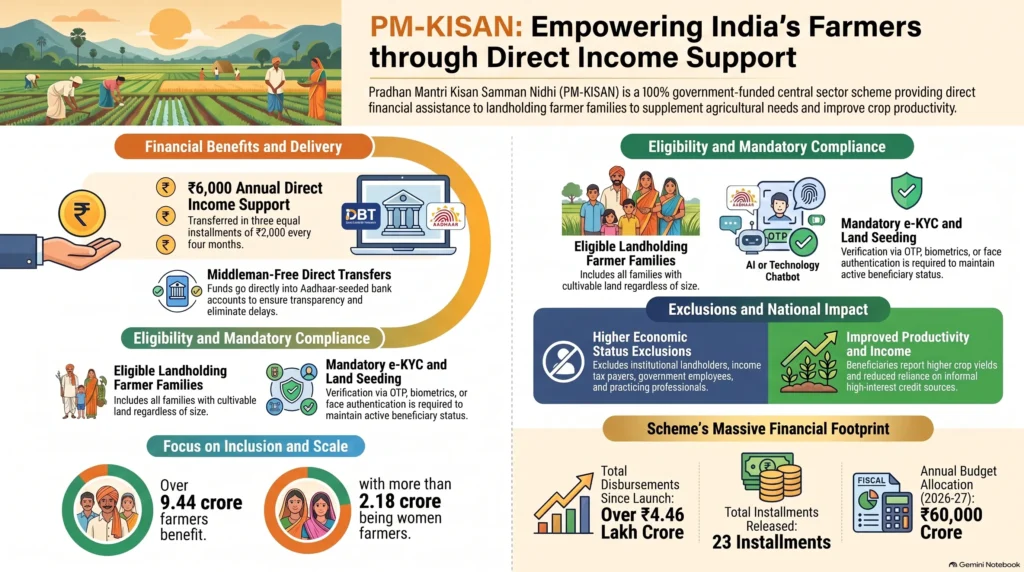
Under this federal policy framework, eligible landholder farmer families receive a financial benefit of ₹6,000 per annum. This amount is payable in three equal quadrimestral installments of ₹2,000 each, disbursed every four months. The funds are transferred directly into the Aadhaar-seeded bank accounts of the beneficiaries via Direct Benefit Transfer (DBT) using the Public Financial Management System (PFMS).
Initially, the program targeted small and marginal farmers with landholdings up to 2 hectares, but its scope was expanded starting April 1, 2019, to cover all cultivable landholding families regardless of land size, subject to specific exclusion guidelines.
Historical Disbursement Dynamics (2025–2026)
Since its inception, the central government has disbursed over ₹4.27 lakh crore under the PM-KISAN scheme. The systematic transfer of financial resources has provided immense support during critical cropping seasons. Below is the historical disbursal tracker for the most recent installments:
- 19th Installment: Disbursed on February 24, 2025, transferring ₹22,000+ crore to more than 9.80 crore eligible farmers.
- 20th Installment: Disbursed on August 2, 2025, transferring ₹20,500+ crore to more than 9.70 crore eligible farmers.
- 21st Installment: Disbursed on November 19, 2025, transferring ₹18,000+ crore to approximately 9.35 crore eligible farmers.
- 22nd Installment: Disbursed on March 13, 2026, transferring ₹18,640 crore to 9.32 crore eligible farmers, including 2.15 crore women farmers.
- 23rd Installment: Disbursed on June 20, 2026, transferring ₹18,880 crore to 9.44 crore eligible farmers, including 2.18 crore women farmers.
- 24th Installment: Covering the August–November 2026 period, this installment is expected in October 2026 based on the scheme’s regular four-month release pattern, though the government has not yet announced an official date.
PM Kisan Status Check 2026: Step-by-Step Guide
Because checking payment status is the most common reason users visit the PM Kisan digital ecosystem, the Ministry of Agriculture has streamlined the checking process through the official portal’s “Farmers Corner”.
How to Check PM Kisan Status by Mobile Number or Aadhaar
Checking your installment delivery status does not require complex logins. Follow this straightforward method to view your payment ledger:
- Visit the Official Website: Go to the homepage of the Pradhan Mantri Kisan Samman Nidhi portal at pmkisan.gov.in.
- Access the Status Portal: Scroll down to the Farmers Corner on the right side of the homepage and click on Know Your Status.
- Provide Credentials: Enter your unique PM Kisan Registration Number.
- Solve Captcha: Type the security code displayed on the screen exactly as it appears.
- Generate OTP: Click the Get OTP button to send a one-time password to your registered, Aadhaar-linked mobile number.
- View Details: Enter the OTP to load your personal dashboard, displaying your registration status, land seeding verification, bank account linkage, and payment history.
If you do not know your unique PM Kisan registration number, you can retrieve it directly from the portal by clicking Know Your Registration Number on the top-right corner of the status page, entering your registered mobile or Aadhaar number, and inputting the OTP. The portal also features an Edit Aadhaar details link where farmers can edit and correct their names themselves if they mismatch their official Aadhaar cards.
What Do Your Installment Status Codes Mean?
When checking your payment ledger, you will encounter specific status codes indicating whether your money has been dispatched or held back. Below is a reference table to help you decode what is happening with your ₹2,000 credit:
- FTO Generated / Payment Confirmation Pending: The state government has verified your records and signed the Fund Transfer Order (FTO). The file is in queue for bank clearance, and funds are typically credited within 48 to 72 hours.
- Payment Stopped by State on Request: Your installment has been temporarily frozen by state authorities due to a physical land record or eligibility audit. Visit your local District Agriculture Office or Block Nodal Officer to complete physical verification.
- Aadhaar Not Seeded: The system tried to initiate a DBT transfer, but your Aadhaar number is not linked to your active bank account on the NPCI mapper. Submit the Aadhaar Seeding and NPCI Mapping form to your bank branch.
- eKYC Pending: Your mandatory annual electronic identity verification has lapsed, putting a hard block on further payouts. Complete eKYC instantly to resume payments.
- Land Seeding: No: The central database cannot link your digitised land records (patta or land survey numbers) to your PM-KISAN registration profile. You must present your land registration mutation papers to the village revenue officer (patwari or tehsildar) to manually update your record in the state revenue directory.
Mandatory PM Kisan eKYC Online Verification (2026)
To prevent impersonation, deduplicate databases, and ensure that tax-funded benefits flow exclusively to genuine farmers, the Ministry of Agriculture has made annual electronic Know Your Customer (eKYC) renewal mandatory. If your eKYC is incomplete or pending, your upcoming Direct Benefit Transfer installments will be suspended.
The Government of India has confirmed that the official deadline to complete mandatory eKYC is June 30, 2026. There are three official ways to complete this verification process:
Method 1: OTP-Based eKYC via pmkisan.gov.in (Aadhaar-Linked Mobiles)
If your Aadhaar card is linked to your active mobile number, this is the fastest, free method:
- Navigate to the official portal: pmkisan.gov.in.
- Under the Farmers Corner, click on the prominent e-KYC tab.
- Enter your 12-digit Aadhaar Card number and click Search.
- Enter the active mobile number that is registered with your Aadhaar Card.
- Click Get OTP to receive a one-time password.
- Type the OTP received from UIDAI on your mobile and click Submit.
Method 2: Face Authentication on the PM-KISAN GoI App
For elderly farmers whose biometrics have faded, or for those whose active mobile numbers are not linked to Aadhaar, the government has launched a highly advanced facial recognition system using AI:
- Download the official PM Kisan GoI App and the Aadhaar Face RD app from the Google Play Store.
- Open the PM Kisan App and log in using your registered mobile number and OTP.
- Navigate to the beneficiary status page and click on the e-KYC option.
- Enter the beneficiary’s Aadhaar number and give your consent to scan your face.
- Position your face in front of the camera in a well-lit area. Once the scan is successful, the eKYC completes instantly.
Method 3: Biometric eKYC at Common Service Centres (CSCs)
If you do not have a smartphone or struggle with digital portals, you can visit any local Common Service Centre (CSC):
- Present your Aadhaar Card to the operator, who will initiate biometric authentication using a fingerprint scanner or iris reader.
- While online self-verification is free, CSC operators are legally authorized to charge a regulated, nominal convenience fee of ₹15 for eKYC.
Troubleshooting PM Kisan Installment Failures & Technical Errors
Despite a highly automated digital pipeline, empirical studies reveal that technical friction points continue to disrupt payments for millions of farmers. In a comprehensive study spanning five southern Indian states (Kerala, Karnataka, Tamil Nadu, Andhra Pradesh, and Telangana), which surveyed 1,900 farmers, 75.4% of respondents cited irregular fund disbursement as a critical constraint. Similarly, a Guntur-based evaluation of 640 smallholder farmers showed that 72.50% of respondents agreed that delayed installment release disrupted their farming operations.
Here is how to resolve the most common payment failures:
Aadhaar-to-Bank Seeding & NPCI Mapper Verification
Direct Benefit Transfers are executed using your Aadhaar number as your unique bank address. The National Payments Corporation of India (NPCI) routes the money to the bank account last mapped to your Aadhaar.
- The Problem: Payouts bounce when banks unilaterally de-seed Aadhaar accounts due to inactivity, or when a farmer opens a new bank account, changing the NPCI mapping without their knowledge. This is a massive issue nationwide: as of recent government data, over 30.18 lakh farmers have pending Aadhaar-bank account seeding issues across India. Top affected states include Uttar Pradesh (1,044,200 pending cases), Gujarat (290,358), Rajasthan (213,779), Madhya Pradesh (187,011), Maharashtra (172,349), and Bihar (139,430).
- The Solution: Submit the Aadhaar Seeding and NPCI Mapper Integration Form to your bank branch. Ensure you check the box reading: “I want to link my bank account to the NPCI mapper to receive DBT benefits.”
Land Seeding and Digitised Bhumi Record Mismatches
Because landholding is the primary eligibility criterion, your name on your land deed must match your Aadhaar record exactly.
- The Problem: In instances of inheritance or land division, name changes on the land registry (patta) are delayed. Outdated land registries exclude up to 88.8% of otherwise eligible farmers from receiving support.
- The Solution: Visit your local Block Development Office or the Tehsildar’s revenue court. Present your land registration mutation papers, along with an Aadhaar copy, to manually update your record in the state revenue directory.
To streamline this process, the Ministry of Agriculture introduced AgriStack—a digital public infrastructure designed to streamline welfare delivery by assigning each farmer a unique, verified Farmer ID (FID). As of July 20, 2026, the AgriStack Farmers Registry had successfully generated over 10.18 crore unique Farmer IDs nationwide. Top states leading generation include:
- Uttar Pradesh: 24,352,649 IDs generated.
- Maharashtra: 13,505,033 IDs generated.
- Madhya Pradesh: 11,353,326 IDs generated.
- Rajasthan: 8,723,010 IDs generated.
- Karnataka: 6,443,972 IDs generated.
- Gujarat: 6,225,462 IDs generated.
- Bihar: 5,531,133 IDs generated.
- Andhra Pradesh: 5,042,388 IDs generated.
- Telangana: 5,002,227 IDs generated.
How to Demand Answers for Stuck Installments: Grievances & RTI
If your portal status is error-free, yet your ₹2,000 installment remains stuck, you have legal channels to demand a resolution:
- Use the Kisan e-Mitra AI Chatbot: In September 2023, the government launched Kisan e-Mitra, a voice-based AI chatbot integrated directly on the home portal. Operating 24/7 in 11 native languages (including Hindi, English, Tamil, Bengali, Odia, Malayalam, Gujarati, Punjabi, Kannada, Telugu, and Marathi), the chatbot has successfully resolved over 95 lakh queries from 53 lakh farmers.
- File an Online Grievance: Submit a query on the PM-KISAN Helpdesk Query Form or file a complaint on the central government’s public CPGRAMS Portal (
pgportal.gov.in), which is monitored by senior ministry officials. - File an RTI Application: Under Section 6 of the Right to Information (RTI) Act, 2005, public CPIOs are legally bound to provide an official update on your application within 30 days. Guntur studies show that 83.8% of farmers lack awareness of grievance resolution channels—filing a formal RTI with a ₹10 fee is the most effective way to clear a stuck cycle.
Use this legally-sound RTI format to draft your application:
To:
The Central Public Information Officer (CPIO)
Department of Agriculture and Farmers Welfare, Krishi Bhavan, New DelhiSubject: Information under the RTI Act, 2005 regarding stuck PM-KISAN installments
Dear Sir/Madam,
Please provide the following information regarding my PM-KISAN registration under the RTI Act, 2005:
- What is the current status of my PM-KISAN registration number:
[Insert Registration Number]?- Specify the exact reason(s) why my financial installment for the cycle
[Insert Cycle, e.g., Dec-Mar 2025-26]has not been credited.- Provide the name, designation, and contact details of the officer currently dealing with my file.
- Provide a certified copy of the daily movement and file-noting records of my application over the last 30 days.
- What is the tentative date by which my held installment will be processed and disbursed?
- Please confirm whether my Aadhaar-Bank NPCI mapping is marked as active in your system.
I have enclosed the application fee of ₹10 (via Indian Postal Order/Court Fee Stamp).
Yours sincerely,
[Your Name, Full Address, and Mobile Number]
Who is Eligible for the PM Kisan Scheme?
Welfare benefits under the PM-KISAN scheme are strictly targeted. To prevent the leakage of public funds to affluent households, the government maintains a clear set of eligibility and exclusion guidelines.
Eligibility Guidelines for Landholding Families
- Land Ownership: The primary eligibility requirement is that the beneficiary family must own cultivable land registered in their name in the state land records.
- Family Unit: For the purposes of this scheme, a “family unit” is strictly defined as a husband, wife, and minor children. They cannot register separately to claim multiple benefits; their landholdings are assessed collectively.
- Exclusions for Renting Out: The Guntur evaluation revealed a strong consensus that the scheme should strictly support active cultivators—with 95.9% of surveyed farmers agreeing that landholders who rent out their land should be excluded from receiving PM-KISAN benefits.
Mandatory Exclusions (Higher Economic Status)
The following categories of individuals and families are strictly excluded from receiving PM-KISAN benefits, even if they own cultivable land:
- Institutional Landholders: Any agricultural land owned by a trust, cooperative, company, or religious institution is excluded.
- Constitutional Post Holders: Former and current holders of constitutional posts.
- Political Representatives: Former and current Ministers, MPs, MLAs, MLCs, Mayors of Municipal Corporations, and Chairpersons of District Panchayats.
- Government Employees: All serving or retired officers and employees of central/state government ministries, departments, field units, public sector enterprises, or local bodies. (Note: This exclusion strictly excludes Multi-Tasking Staff, Class IV, and Group D employees, who remain eligible).
- Pensioners: Retired pensioners whose monthly pension is ₹10,000 or more. (Multi-Tasking Staff, Class IV, and Group D pensioners are eligible).
- Income Tax Payers: Any individual who paid income tax in the last assessment year.
- Practicing Professionals: Registered professionals, including doctors, engineers, lawyers, Chartered Accountants (CAs), and architects actively running a practice.
Combining PM Kisan with State Direct Benefit Transfer Schemes
One of the most attractive features of the Indian agricultural welfare model is that PM-KISAN is not mutually exclusive. Farmers are encouraged to stack state-level income support programs on top of the central scheme, allowing families to significantly boost their seasonal working capital.
Below is a detailed analysis of how regional schemes integrate with PM-KISAN:
Andhra Pradesh: Annadata Sukhibhava
In Andhra Pradesh, the flagship income support program is Annadata Sukhibhava. Under this stacked scheme, eligible farmers receive a substantial annual aid package of ₹20,000 per year. This is structured as a co-funded payout: ₹14,000 is contributed by the AP state government, while the remaining ₹6,000 is routed from the central PM-KISAN scheme.
- Policy Transition: Rebranded and launched in June 2024 by the TDP-led government, it replaced the previous YSR Rythu Bharosa scheme.
- Latest Disbursal: On June 20, 2026, Chief Minister N. Chandrababu Naidu released ₹3,125 crore under the program, disbursing the first installment of ₹7,000 (₹5,000 state contribution + ₹2,000 central PM-KISAN benefit) directly into the accounts of approximately 46.85 lakh farmer families.
- Helpline Support: For payment issues, farmers can dial the dedicated state support helpline at 155251 or the general AP farmer helpline at 1902.
Telangana: Rythu Bharosa
Telangana pioneered per-acre investment support with the Rythu Bandhu program, which has since been restructured and rebranded as the Rythu Bharosa scheme.
- Annual Financial Aid: Telangana farmers receive ₹12,000 per acre each year.
- Disbursal Structure: This support is split into two seasonal payouts of ₹6,000 per acre for the Kharif (monsoon) and Rabi (winter) crop cycles.
Frequently Asked Questions (FAQs)
When is the PM Kisan 24th Installment Expected?
Based on the scheme’s strict four-month cycle pattern, the 24th installment (covering the August–November 2026 period) is expected to be released in October 2026. The preceding 23rd installment was successfully released on June 20, 2026, transferring ₹18,880 crore to approximately 9.44 crore eligible farmers.
Can both Husband and Wife receive PM Kisan separately?
No. PM-KISAN defines a beneficiary as a single landholder family unit, comprising a husband, wife, and minor children. Even if both spouses own separate land plots under different revenue registries, only one member of the family is eligible to receive the ₹6,000 annual aid. If both register separately, it violates scheme guidelines; the duplicate profile must be closed using the Voluntary Surrender option on the portal.
Is eKYC completely free of charge?
Yes, eKYC is completely free if completed online. If you perform OTP-based self-verification on the official portal (pmkisan.gov.in) or use the facial recognition scanning module on the official PM Kisan GoI app, you will not be charged. However, if you choose to complete biometric-based fingerprint verification at a local Common Service Centre (CSC), the operator is legally permitted to charge a nominal, government-regulated convenience fee of ₹15 for eKYC.
Need further assistance?
For direct assistance regarding pending payments, land mutations, or technical database errors, you can contact the official PM-KISAN National Helpline at 155261 or 011-24300606. Alternatively, seek instant native-language support from Kisan e-Mitra, the official voice-based AI chatbot integrated directly on the home portal, which has successfully resolved over 95 lakh queries.