The Thalliki Vandanam Scheme (which translates to “Mother’s Salute”) stands as one of the most critical flagship welfare programmes introduced by the Government of Andhra Pradesh under the leadership of Chief Minister N. Chandrababu Naidu and the National Democratic Alliance (NDA) coalition government. Designed as a targeted educational direct benefit transfer (DBT) system, the program’s core objective is to incentivize school education, boost student enrolment, and reduce dropout rates among economically vulnerable households by financially empowering mothers.
Officially launched under Government Orders (G.O.) MS No. 26 and 27 on June 12, 2025, the initiative represents a significant evolution in public policy and welfare design. Releasing financial help directly into the hands of mothers ensures that no student is forced to drop their studies due to a financial crunch.
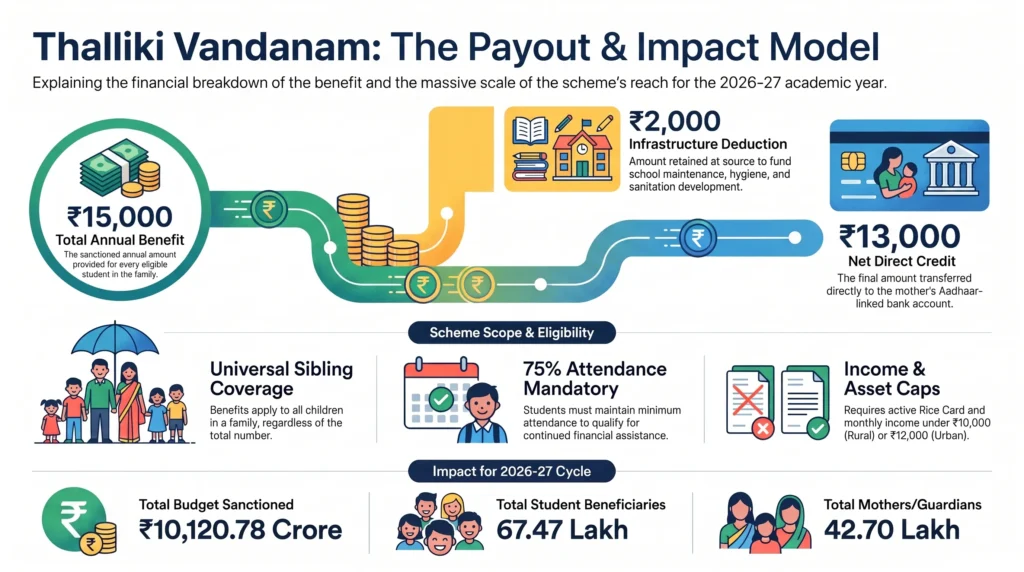
For the current academic year 2026–27, the school education department, led by Secretary Kona Sasidhar, formally sanctioned a massive budget of Rs. 10,120.78 Crore under G.O.MS.No. 16 (issued on July 16, 2026). The scheme’s total targeted beneficiary pool for the year covers 67,47,190 students belonging to 42,70,802 eligible mothers or guardians across Andhra Pradesh. The formal rollout and first-phase disbursement commenced on July 22, 2026, directly crediting assistance to 64,76,590 verified students associated with 41,07,502 mothers and guardians.
What is the AP Thalliki Vandanam Scheme?
At its heart, the Thalliki Vandanam Scheme is a social protection initiative that provides financial assistance to mothers or legal guardians of school-going children to ease the burden of educational expenses. The scheme provides an annual financial benefit of Rs. 15,000 per eligible student who is enrolled in recognized government, private aided, private unaided, or residential schools and junior colleges from Class I to Class XII (Intermediate).
Transition from YSR Amma Vodi to Thalliki Vandanam
The transition from the previous YSRCP government’s Jagananna Amma Vodi scheme to the NDA coalition’s Thalliki Vandanam introduced a fundamental shift in welfare design. While the Amma Vodi scheme also provided Rs. 15,000 annually, it restricted the financial payout to only one child per household, regardless of how many siblings in that family were actively enrolled in school. This household cap often forced impoverished parents with multiple children to make difficult choices regarding which child’s education to prioritize.
Thalliki Vandanam completely eliminates the “one-child-per-household” restriction. Under the current guidelines, the Rs. 15,000 annual benefit is extended to every school-going child within an eligible family, allowing large families to receive cumulative support proportional to their household education costs.
For example, real-world implementations in districts like Kadapa and Anantapur have documented multiple sibling payouts. A notable family—Lavade Sharada from Bakkannagari Palle in Vempalle mandal under the Pulivendula segment—has five children enrolled in school and received a cumulative Rs. 1.04 Lakh in aid during the first phase of the new scheme. Similarly, Ramanjinamma from Ankampalli village in Belaguppa mandal has six daughters; five of them were successfully verified and paid during the first phase.
This shift recognizes that educational expenses scale linearly with the number of children in a household, ensuring the welfare safety net covers the complete primary and secondary education of all siblings. Furthermore, the program broadens eligibility beyond strict Below Poverty Line (BPL) limits by offering coverage to non-BPL families whose children attend government and government-aided schools, positioning public institutions as viable, quality alternatives to private schooling.
Financial Payout Breakdown: Rs. 13,000 vs Rs. 15,000
Although the program’s official benefit is declared as Rs. 15,000 per child, beneficiaries do not receive this full amount in their bank accounts. The state government operates a mandatory source deduction mechanism of Rs. 2,000 per student.
Consequently, Rs. 13,000 is directly credited via the Direct Benefit Transfer (DBT) system into the mother’s Aadhaar-seeded bank account. The remaining Rs. 2,000 is deducted at source and credited to dedicated accounts controlled by respective District Collectors. Under the Standard Operating Procedure (SOP) formulated by the School Education Department, these funds are utilized for the overall development of the educational ecosystem, focusing on public school and junior college infrastructure, toilets, structural sanitation, and clean drinking water.
Detailed Thalliki Vandanam Eligibility Criteria
To prevent programmatic leakage and ensure that public resources are directed toward economically vulnerable households, G.O. MS No. 26 establishes a rigorous set of resource caps and eligibility parameters.
Household Asset and Income Resource Caps
For a family to qualify for the scheme, they must satisfy the following strict criteria:
- Monthly Household Income: The total monthly household income must not exceed Rs. 10,000 in rural areas and Rs. 12,000 in urban areas.
- Ration Smartcard Status: The household must possess an active, verified white Rice Card issued by the Department of Civil Supplies.
- Agricultural Landholdings: The total agricultural holdings of the household must be under 3 acres of wet land, under 10 acres of dry land, or a combined total under 10 acres of wet and dry land.
- Utility Consumption Threshold: The household’s average monthly electricity consumption over the preceding 12 months must be below 300 units.
- Four-Wheeler Ownership: No member of the household may own a personal four-wheeled vehicle. (Note: Commercial taxis, agricultural tractors, and passenger auto-rickshaws are officially exempt from this restriction).
- Municipal Real Estate Asset: The household must not own residential or commercial property exceeding 1,000 square feet within municipal jurisdictions.
- Employment Restrictions: No household member may be an active government employee, a Public Sector Unit (PSU) staff member, an active Income Tax (IT) payer, or a post-retirement government pension recipient.
- Special Professional Exemptions: Sanitation workers, Anganwadi workers, and outsourced public staff are officially exempted from the government employment exclusion. This fulfills a prominent promise made by Education Minister Nara Lokesh to protect low-income public workers.
Academic Enrollment and Attendance Conditions
In addition to household economic criteria, the student must fulfill strict academic conditions:
- Enrolled Institutions: Students must be actively enrolled in recognized government, private aided, private unaided, or residential schools and junior colleges within Andhra Pradesh.
- Specific Course Exclusions: Students pursuing courses in ITI, Polytechnic, and RGUKT (IIIT) are excluded from Thalliki Vandanam because these programs utilize independent, separate tuition fee reimbursement frameworks.
- RTE Section 12(1)(c) Admissions: For children admitted into recognized private unaided schools under Section 12(1)(c) of the Right to Education (RTE) Act, 2009, the government-fixed tuition fee is deducted from the Rs. 15,000 benefit and routed directly to the school management, with the remainder credited to the mother.
- The 75% Attendance Rule: To maintain eligibility for subsequent funding cycles, students must maintain a minimum of 75% school attendance throughout the academic year. Discontinuing studies or failing to meet this threshold results in automatic disqualification for the next year.
How to Check Thalliki Vandanam Status Online (Step-by-Step)
The scale of the Thalliki Vandanam scheme creates high demand for real-time validation data. Because official state portals can face performance bottlenecks or high server latency during peak disbursement periods, several regional portals act as secondary information sources. However, the safest and only authorized route for citizens to check their eligibility is through the state’s official digital systems.
Method 1: Checking Status on the Official Portal
Beneficiaries can check their real-time validation status, eligibility, and payment records on the official AP Beneficiary Management status portal:
- Open your mobile or desktop web browser and navigate directly to the official URL:
bm-sgsw.ap.gov.in/BM/Schemeout. - Locate the dropdown menu on the homepage and select “Thalliki Vandanam” as the Scheme Type.
- Choose the active academic year “2026–2027”.
- Enter the mother’s (or registered legal guardian’s) 12-digit Aadhaar Card number.
- Input the unique captcha code displayed on the screen and click the “Get Details” button.
- A secure, automated One-Time Password (OTP) will be sent to the mobile number linked with the Aadhaar. Enter this OTP into the portal to complete verification.
- The portal will display your comprehensive record, showing your “Validation Status” (e.g., Eligible, Ineligible, or Pending for Verification) along with bank credit details.
Method 2: Accessing Status via the LEAP Mobile Application
Alternatively, citizens and field-level coordinators can access status data through the official LEAP mobile application. The app-based status check follows these steps:
- Open the LEAP app on your smartphone and log in.
- Navigate to the “Welfare Status” or “Scheme Status” menu options.
- Select “Thalliki Vandanam” from the active scheme registry.
- Enter requested details such as Aadhaar number, APAAR ID, PEN number, or registered mobile number.
- Click submit to view your household’s eligibility status, school-related verification, and family details.
Method 3: Quick Status Verification via WhatsApp Integration
To assist families facing technical challenges with web portals, the government has integrated status tracking into its automated WhatsApp Governance chatbot.
- Save the official government WhatsApp number to your contacts: 9552300009.
- Open WhatsApp and send the message “Hi” to the saved contact.
- The automated chatbot will reply with a service menu. Select the “Thalliki Vandanam” option from the list.
- Input the mother’s Aadhaar card number or registered mobile number when prompted.
- The chatbot will immediately retrieve and display your current eligibility, verification status, and payment credit records.
Technical Verification and the GSWS Field-Verification Process
Behind the digital interface lies a highly integrated data verification system managed by the Andhra Pradesh Centre for Financial Systems and Services (APCFSS). School admissions data provided by the School Education Department is cross-referenced with civil supplies, municipal, utility, and land registries through a six-stage technical validation pipeline.
The Six-Stage Validation Pipeline
During data matching, several demographic and database anomalies are flagged. These anomalies are pushed down to field secretariats, where Welfare Education Assistants (WEA) and Ward Welfare Development Secretaries (WWDS) perform local field verification using the mobile-based Beneficiary Management portal to correct the database.
Handling Complex Family Registry Scenarios via the LEAP App
Using the LEAP field-verification module, field secretaries resolve specific household registry errors through structured scenario actions:
- Scenario 1.1 (Mother is Alive): The WEA/WWDS verifies the mother’s physical presence, updates her demographic profile, and completes maternal-child linkage in the state tree.
- Scenario 1.2 (Divorced Parents): In cases of parental divorce, the WEA/WWDS verifies legal custodial relationships. Under sub-options, the child is mapped either to the father’s active Aadhaar (if the student lives with the father) or to the legal guardian’s active Aadhaar.
- Scenario 1.4 (Mother Demised): If the mother is deceased, the field officer verifies the death certificate. The system is then updated to credit the annual Rs. 15,000 benefit directly to the surviving father’s bank account or the designated guardian’s bank account.
- Scenario 2.1 (No Relational Linkage): Flagged when the database contains no relational link between the registered student and adult. If the adult has no relationship to the child, the officer submits the discrepancy. If the student’s record is verified, the officer submits Aadhaar corrections.
- Scenario 3.1 & 3.2 (Aadhaar Migration): When family members reside in different regions, this module allows field officers to migrate the student’s or mother’s Aadhaar records across household units to match their physical residence, preventing duplicate payouts across separate village secretariats.
- Scenario 3.4 (Orphan Status): Orphans and street children enrolled in schools through registered voluntary organizations are verified. The financial benefits are routed directly to respective District Collectors, who oversee disbursement and verify appropriate expenditure.
Troubleshooting Payout Delays and Grievance Registration
Even when a household is marked “Eligible” on the status portal, payout delays can occur due to downstream banking and administrative issues.
Aadhaar Seeding and NPCI Mapping Hurdles
The most common cause of failed DBT transfers is incomplete Aadhaar seeding or failed National Payments Corporation of India (NPCI) mapping on the mother’s bank account.
- Aadhaar Seeding: The beneficiary’s bank account must be actively linked with their Aadhaar card. If unlinked, the mother must visit her local bank branch and submit an Aadhaar seeding form.
- NPCI Mapping: The account must be mapped to the NPCI mapper to accept Aadhaar-enabled government transfers. Beneficiaries must request the bank to activate Aadhaar Enabled Payment System (AePS) on their account. Status can be checked via bank mobile apps or the UIDAI portal.
Filing Grievances Online and Offline
For households marked “Ineligible” or facing database errors (such as incorrect electricity readings or vehicle flags), the state provides clear channels for appeal and rectification:
- Offline Grievance Submission: Visit your local Village or Ward Sachivalayam (Secretariat). Meet with the local WEA/WWDS and submit your student school records, active Rice Card, land registries, electricity bills, and bank passbooks to file an objection.
- Online Grievance Tracking: Register and monitor objections on the state’s dedicated grievance dashboard at
bm-sgsw.ap.gov.in/BM/Grievancestatus. - AP Spandana PGRS Portal: If local resolution fails, register a formal complaint on the statewide AP Spandana Public Grievance Redressal System (PGRS) portal at
pgrs.ap.gov.in. This allows users to track the administrative workflow and resolution of their complaints.
Key Scheme Timelines and Payment Calendars (AY 2026-27)
To maintain administrative structure, the Department of School Education and the Department of Swarna Gramam Swarna Wardu (SGSW) adhere to a strict welfare calendar.
Below is the official schedule for database updates, grievance windows, and disbursements for the Academic Year 2026–27:
| S. No | Key Project and Welfare Activity | AY 2026–27 Official Schedule | Administrative Impact and Target Cohort |
|---|---|---|---|
| 1 | First Phase DBT Disbursement | July 22, 2026 | Released Rs. 10,120.78 Crore to 64,76,590 verified, dispute-free student records. |
| 2 | Sachivalayam List Publication | July 22, 2026 | Eligible and ineligible lists displayed at local Gram Panchayat and Ward offices for social audit. |
| 3 | Objection & Grievance Window | July 22, 2026 – August 3, 2026 | Window for rejected applicants to register objections online or at local secretariats. |
| 4 | Field Grievance Verification | August 4, 2026 – August 10, 2026 | Field verification by WEA/WWDS teams to resolve flagged objections and database errors. |
| 5 | Fresh Admissions Cut-off Date | August 25, 2026 | Deadline for schools to complete enrollment and submit verified records for new Class I & Jr. Inter students. |
| 6 | Supplementary DBT Disbursement | August 30, 2026 | Final disbursement of supplementary funds covering fresh admissions and corrected grievance records. |
Frequently Asked Questions (FAQs)
What is the main difference between Amma Vodi and Thalliki Vandanam?
Under the old Amma Vodi scheme, the annual financial benefit was restricted to only one child per mother, regardless of how many siblings in that family were enrolled in school. Thalliki Vandanam removes this household cap, providing the Rs. 15,000 annual benefit for every school-going child in an eligible family.
Why did I receive Rs. 13,000 in my bank account instead of the promised Rs. 15,000?
While the sanctioned benefit is Rs. 15,000 per child, the government implements a mandatory source deduction of Rs. 2,000 per student. This deducted Rs. 2,000 is routed directly to accounts managed by District Collectors and utilized specifically for public school maintenance, structural sanitation, water hygiene, and toilet upgrades. The remaining Rs. 13,000 is directly credited to the mother’s account.
Are private school students eligible for the Thalliki Vandanam Scheme?
Yes. Students enrolled in recognized government, private aided, and private unaided schools or junior colleges are eligible. However, for students admitted under RTE Section 12(1)(c) in private schools, the government-fixed tuition fee is deducted from the Rs. 15,000 benefit and paid directly to the school management, with only the remaining balance credited to the mother’s account.
Is the scheme applicable to Polytechnic, ITI, or IIIT (RGUKT) courses?
No. Students enrolled in ITI, Polytechnic, or RGUKT (IIIT) courses are excluded from Thalliki Vandanam because these professional courses utilize independent, dedicated tuition fee reimbursement frameworks.
What is the minimum school attendance required to receive benefits?
The student must maintain a minimum of 75% attendance throughout the academic year to remain eligible for subsequent funding cycles.
Can a father receive the benefit if the mother is deceased or absent?
Yes. While the payment is primarily credited to the mother’s Aadhaar-seeded bank account, in single-parent families where the mother is demised or absent, the payment is credited directly to the father’s or the recognized legal guardian’s bank account.
Disclaimer: This article is a comprehensive informational guide compiled from official guidelines, government orders, and state administrative manuals for the Thalliki Vandanam Scheme. Beneficiaries are encouraged to verify their records on the official government web portals before deadlines.